


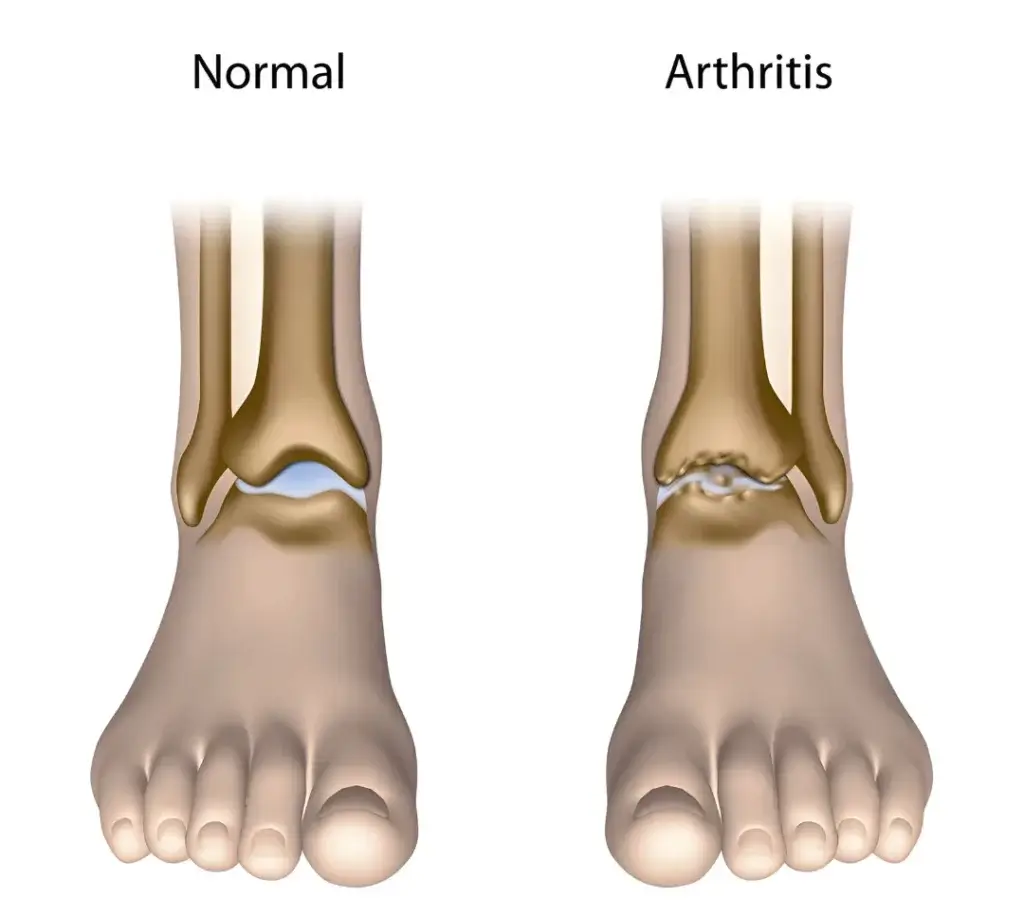
Most patients are aware of the terms “Hip Replacement” or “Knee Replacement,” but the term Ankle Replacement is still quite new in South Africa. However, as Ankle replacements have improved significantly over the last 15 to 20 years, it is becoming a more common surgery for patients with end-stage, bone-on-bone, grade 4 osteoarthritis of the ankle.
An ankle replacement, also known as total ankle arthroplasty, is a surgical procedure where a damaged ankle joint is replaced with artificial components. The goal is to relieve pain and maintain movement, allowing patients to return to a pain-free lifestyle with improved quality of life.

Who Might Need an Ankle Replacement?
There should be good patient insight, as they need to understand an ankle replacement, its maintenance, and the associated requirements. One must realize that this surgery will not allow a high activity demand lifestyle post replacement.
You are a good candidate for an ankle replacement if:
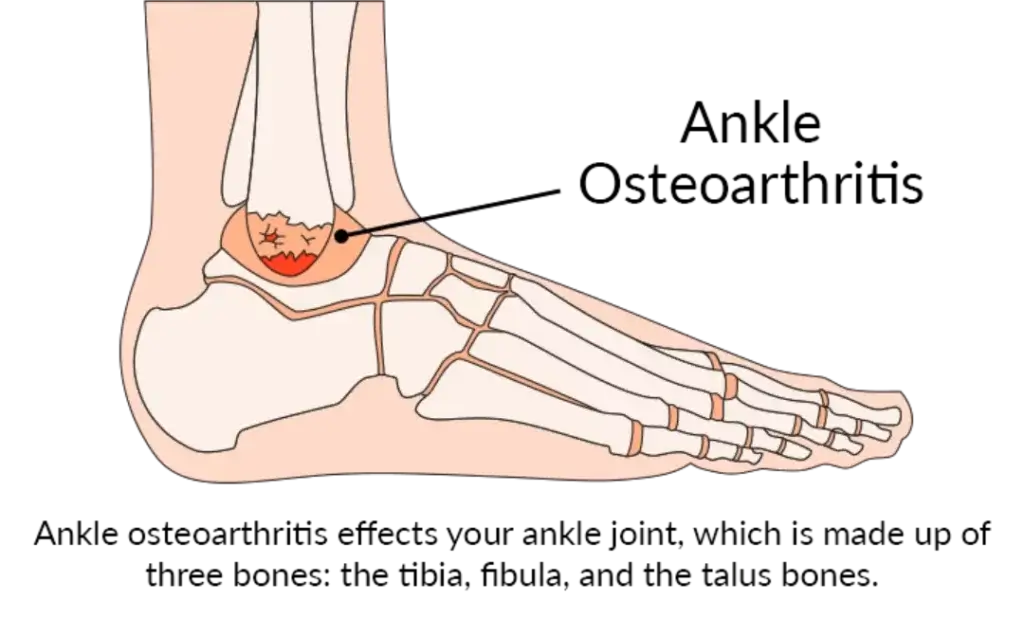
- You have end-stage, bone-on-bone, grade 4 osteoarthritis of the ankle.
- The talus (the bone below the ankle) must be in good condition.
- You experience chronic pain and stiffness that limits daily activities.
- You have not found relief from non-surgical treatments like medications, physical therapy, or braces.
- You are older than 50 years.
- You have a low-demand lifestyle.
You are NOT a good candidate for an ankle replacement if:
- There is a deformity above 10 degrees in the ankle joints.
- You have a previous infection in the ankle.
What does an ankle replacement entail?
- The foot and ankle orthopaedic surgeon will consult with the patient to ensure that they are a good candidate for surgery by examining the ankle, referral reports, clinical history (including imaging) and will decide on the surgery together with the patient after weighing all options.
- During the surgery, the arthritic and devascularised bone will be removed with precise bone cuts on the ankle, specifically from the tibia and the talus.
- Precise measurements of the size of the prosthesis will be performed, and an ankle replacement will be placed with metal plates on the tibia and talus surfaces, and a polyethylene inserted to maintain motion.
- This is typically a surgery with one overnight hospital stay.
- After the surgery, the patient is placed in a cast for approximately six weeks.
- The foot and ankle orthopaedic surgeon will see the patient for wound care 2 weeks after surgery.
- After four weeks, the patient can start touch weight-bearing.
- Six weeks after the surgery, the cast is removed, and the patient is placed in a moon boot.
- A progressive increase in weight bearing occurs with physiotherapy and rehabilitation.
- At 10 weeks, the moon boot is removed, and the patient continues with physiotherapy.
- Patients can progressively increase their function and activities.
- Most patients can return to normal living around 12 weeks after surgery, with higher functions continuously improving thereafter.
This is an example of the typical procedure and may vary on a case-to-case basis.

Example of an ankle replacement
What is the alternative to an ankle replacement?
An alternative procedure for end-stage ankle osteoarthritis is an ankle fusion. The literature shows that both are good surgical procedures with good and equal long-term outcomes. Ankle replacements have progressively improved functional outcomes and are currently, according to the latest literature, equal to ankle fusions. Both surgeries will equally improve a patient’s quality of life and produce a pain-free joint. Let’s compare the two surgeries.
An ankle replacement is a surgical procedure where a damaged ankle joint is replaced with artificial components to maintain the ankle’s range of motion.
The advantages of the ankle replacement are that:
- The patient will have improved gait after surgery, especially on inclines.
- The ankle replacement will maintain the movement available before surgery and thereby protect the adjacent foot joints from further wear and tear.
The disadvantage of an ankle replacement is its longevity. Approximately 75% of patients will still have a functional ankle replacement at 15 years post-replacement. This means that one out of four would have had to have revision surgery or ankle fusion within 15 years. There’s also a possibility that one might need a “maintenance surgery” within the 15 years, such as bone debridement, cyst, bone graft, polyethylene exchange, to name a few.
An ankle fusion is a type of surgery to fuse the bones of your ankle joint. The other joints of the foot remain mobile – you will thus not have a stiff foot.
The main goal of an ankle fusion is to relieve severe pain, improve ankle stability, and enhance function for patients with severe ankle arthritis.
The advantages of an ankle fusion are that:
- It is more durable compared to an ankle arthroplasty (replacement).
- Ankle fusions are also very good for severe deformity corrections and have a lower reoperation rate.
However, the disadvantage of an ankle fusion is that because the ankle is stiff, the surrounding joints will have to maintain foot movement, and therefore, one can get adjacent joint osteoarthritis after approximately 15 years.
To conclude
Ankle replacements are continuously improving in outcomes and longevity, and there’s a viable method for the treatment of end-stage ankle osteoarthritis in the patient with the correct indications. When considering your surgeon for this surgery, a fellowship trained Orthopaedic surgeon with a special interest in foot and ankle will be your best option.

About the author
Dr Jaco Naudé is a fellowship-trained orthopaedic surgeon specialising in foot and ankle surgery. He completed a Foot and Ankle Fellowship through the University of the Witwatersrand. In private practice since 2021, he consults and operates at multiple hospitals in Pretoria, focusing on elective and trauma-related foot and ankle conditions with an emphasis on patient-centred outcomes. Dr. Jaco Naudé is dedicated to continuous learning, participating in international courses, and has authored several peer-reviewed articles in International Journals while actively engaging in academic orthopaedics.
